
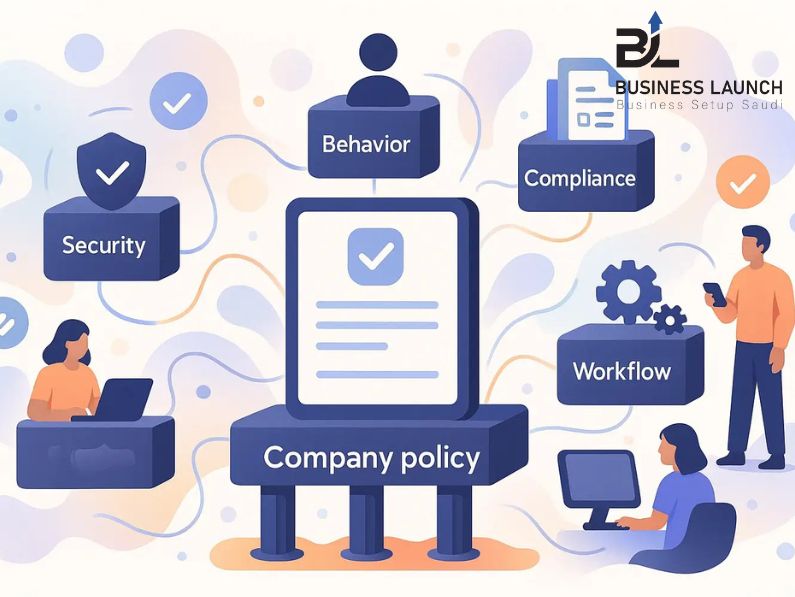
Building a business from the ground up requires more than an innovative product and aggressive marketing. Operational resilience, regulatory compliance, and workplace culture depend heavily on a solid foundation of governance. When establishing a business, identifying what a company needs in terms of formal guidelines is the single most critical step toward preventing disputes, protecting assets, and scaling efficiently.
Without written operational protocols, expanding enterprises face severe legal exposure, employee confusion, and regulatory non-compliance. Aligned with national economic frameworks like Saudi Vision 2030, businesses operating in modern dynamic markets must institute legal clarity from day one.

Why Strategic Internal Policies are Mandatory for Early-Stage Growth
Internal policies serve as an operational playbook. They define acceptable behaviors, establish leadership hierarchies, and outline standardized procedures for handling workplace scenarios. A startup operating without structured guidelines exposes itself to unnecessary friction and legal vulnerability.
Key reasons why every company needs proactive policy drafting include:
-
Risk Mitigation & Liability Protection: Documented policies protect founders and directors from personal liability in legal disputes involving wrongful termination, harassment, or financial misconduct.
-
Operational Consistency: Clear guidelines eliminate ambiguity, enabling teams to execute routine operations without requiring constant executive oversight.
-
Regulatory Compliance: Local laws dictate strict employment, taxation, and data handling standards. Formal policies ensure continuous adherence to statutory mandates.
-
Investor & Bank Confidence: Venture capital firms, institutional investors, and banking partners evaluate internal governance before granting funding or corporate credit lines.
The 7 Core Internal Policies Every New Company Needs
While operational requirements vary across industries, every commercial enterprise requires a standardized baseline of legal and administrative governance.
1. Code of Conduct & Corporate Ethics Policy
The Code of Conduct defines the core values, moral guidelines, and professional expectations of the business. It sets clear boundaries regarding employee interactions, conflict of interest management, client communication, and anti-bribery standards.
To align with modern statutory expectations, this framework must comply with regulations set forth by the Ministry of Commerce (MoC), ensuring transparent commercial practices and shielding the enterprise from fraudulent transactions.
2. Employment & Human Resources Governance Policy
Human capital management requires strict alignment with local labor legislation. A comprehensive HR policy covers hiring procedures, working hours, probation terms, vacation accruals, remote work standards, and termination protocols.
For enterprises establishing operations in the Middle East, HR policies must systematically incorporate local workforce requirements, Saudization quotas, and digital labor contract registrations managed via the official Qiwa Platform.
3. Financial Governance & Expense Control Policy
Financial ambiguity can rapidly deplete a startup’s runway. A robust financial policy establishes multi-signature approval matrices, procurement procedures, petty cash management, and business expense reimbursement limits.
Furthermore, internal financial policies must integrate seamlessly with local tax and electronic invoicing frameworks overseen by the Zakat, Tax and Customs Authority (ZATCA) to ensure accurate reporting and audit readiness.
4. Data Protection, Cybersecurity & IT Usage Policy
In an increasingly digital economy, proprietary data and customer confidentiality are vital assets. An IT security policy regulates system access credentials, software licensing, hardware usage, bring-your-own-device (BYOD) rules, and data classification protocols.
Establishing clear data privacy standards helps businesses meet corporate registration requirements managed through the Saudi Business Center, demonstrating operational readiness to government regulators and enterprise clients alike.
5. Foreign Investment & Subsidiary Governance Policy
For international ventures expanding across borders or setting up regional headquarters, governance policies must define parent-subsidiary relationships, profit repatriation protocols, and executive voting rights.
Foreign entities entering competitive markets must structure their corporate documentation in coordination with the Ministry of Investment (MISA) to ensure compliance with foreign ownership licensing and operational regulations.
6. Whistleblower Protection & Grievance Policy
To maintain high ethical standards, employees must have a secure channel to report financial irregularities, safety violations, or workplace harassment without fear of reprisal. A whistleblower policy outlines anonymous reporting procedures, independent investigation workflows, and strict anti-retaliation protections.
7. Workplace Health, Safety, and Environment (HSE) Policy
Physical and psychological safety in the workplace is both a moral duty and a legal requirement. An HSE policy defines emergency response procedures, equipment usage protocols, workplace injury reporting, and environmental sustainability standards.
See Also
- Best Free Zones Near Saudi Arabia for Regional Businesses: The Ultimate Strategic Guide
- Business Launch Company Expands to KAFD: Your Gateway to Saudi Arabia’s Economic Frontier
- Increasing Company Capital in Saudi Arabia: The Ultimate Legal & Strategic Guide
- How to Amend a Commercial Registration (CR) in Saudi Arabia: The Ultimate 2026 Guide
- Company Stamp Requirements in Saudi Arabia: The Ultimate 2026 Compliance Guide
Comparative Matrix: Essential Policy Breakdown
Different policies address distinct organizational vulnerabilities. The table below illustrates how key policy categories compare in terms of primary objectives, risk mitigation, and implementation priority.
| Policy Category | Primary Operational Objective | Primary Risk Addressed | Implementation Priority |
| Code of Conduct | Defines behavioral and ethical standards | Fraud, bribery, workplace misconduct | Immediate (Day 1) |
| HR & Labor Compliance | Governs employment terms and workforce management | Labor lawsuits, regulatory fines | Immediate (Day 1) |
| Financial Controls | Regulates spending authority and tax alignment | Embezzlement, tax non-compliance | Pre-Revenue |
| Data Protection & IT | Secures digital assets and personal data | Data breaches, IP theft | Pre-Launch |
| Whistleblower Policy | Protects internal integrity and reporting | Unchecked corruption, cover-ups | Growth Phase |
| HSE Guidelines | Ensures workplace safety and emergency response | Physical injury, regulatory shut-down | Operational Launch |
Step-by-Step Sequence for Implementing Corporate Policies
Developing and deploying workplace policies requires a structured approach to ensure compliance, legal validity, and operational adoption across all organizational levels.
Common Pitfalls to Avoid in Policy Development
-
Using Unvetted Generic Templates: Downloading generic policy documents online often leads to unenforceable clauses or direct violations of local labor laws.
-
Lack of Enforceable Sign-Offs: A policy is legally useless if you cannot prove employees received and agreed to it. Always maintain digital or physical acknowledgement signatures.
-
Over-Complicating Guidelines: Policies filled with dense legal jargon discourage compliance. Write clear, concise, and actionable instructions.
-
Failing to Enforce Rules Consistently: Selective enforcement creates legal liability for discrimination and damages workplace trust.
Professional Advisory & Policy Structuring Services
Setting up an enterprise with robust, legally sound internal policies requires local expertise, regulatory insight, and seamless government coordination.
Business Launch Company is a premier business setup and corporate advisory firm headquartered in Riyadh. We specialize in drafting comprehensive legal charters, HR rulebooks, financial control frameworks, commercial registration (CR) issuing, MISA foreign investment licensing, and complete corporate governance alignment for new enterprises.

Contact Information & Location
-
-
Google Maps Location: Navigate directly via Google Maps
-
LinkedIn Announcement: View the official LinkedIn expansion post
-
Official Website: https://sasetup.com
📞 Direct Phone / WhatsApp: +966 53 783 3585

✉️ Support Email:          [email protected]
-