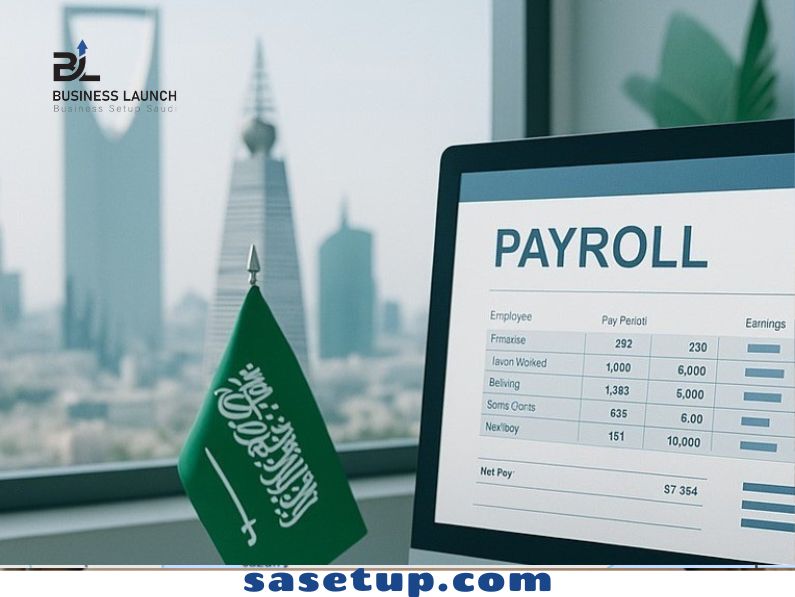
As Saudi Arabia accelerates toward the final milestones of Vision 2030, the regulatory environment for business operations has become increasingly sophisticated and digital-first. For any enterprise entering or scaling within the Kingdom, a robust Payroll Setup Saudi Arabia is not just an administrative task—it is the foundation of legal compliance and operational continuity.
In 2026, the integration between labor portals, social insurance systems, and banking channels is absolute. Failure to align your payroll with systems like Mudad, Qiwa, and GOSI can lead to immediate penalties, blocked visas, and even business suspension. This 1,500-word guide provides a deep dive into the mandatory steps, technical requirements, and strategic nuances of setting up payroll in the Kingdom.

1. The Legal Pillars of Saudi Payroll (2026)
Setting up payroll in the Kingdom requires an understanding of three mandatory government frameworks that operate in real-time synchronization.
A. The Wage Protection System (WPS)
The WPS is a mandatory electronic monitoring system that ensures private sector employees receive their wages on time and in full. In 2026, the WPS is managed primarily through the Mudad Platform. Every salary transfer must generate a “Salary Information File” (SIF) that is uploaded to Mudad for validation against the employee’s registered contract.
B. GOSI (General Organization for Social Insurance)
GOSI handles the social security and occupational hazard insurance for all employees. In late 2024 and throughout 2025, new regulations introduced a “New Social Insurance Law” for employees registered after July 3, 2024. As of 2026, payroll systems must differentiate between “Existing System” and “New System” contributors.
C. The Qiwa Platform
Qiwa is the home of the digital employment contract. Your Payroll Setup Saudi Arabia must perfectly match the figures documented in Qiwa. Discrepancies between the contract salary in Qiwa and the actual transfer in Mudad are the #1 cause of compliance “Red Flags” and automated fines.
2. Step-by-Step: How to Setup Payroll in Saudi Arabia
Step 1: Corporate Foundation & Bank Integration
You cannot run payroll without a local corporate presence.
-
Commercial Registration (CR): Your entity must be active.
-
Corporate Bank Account: You must open a local account with a bank integrated into the Saudi Central Bank (SAMA) network. This is essential for generating the SIF (Salary Information File) required for WPS compliance.
Step 2: Registration on Mudad & Qiwa
The Mudad Platform acts as the technical engine for your payroll.
-
Link your bank account to Mudad.
-
Ensure all employees are registered in GOSI and have active digital contracts on Qiwa.
Step 3: Calculating Contributions (2026 Rates)
As of early 2026, the contribution rates for Saudi nationals have shifted under the new uplift schedule:
-
Existing System (Pre-July 2024): Total 21.5% (Employer: 11.75% | Employee: 9.75%).
-
New System (Post-July 2024): As of July 2026, the rate rises to 23.5% (Employer: 12.75% | Employee: 10.75%) due to the annual 0.5% increment.
-
Non-Saudis: Fixed at 2% (Occupational Hazard), paid entirely by the employer.
Note: The contribution cap for 2026 remains at SAR 45,000 per month (Basic + Housing).
3. Mandatory Payroll Components in KSA
When configuring your Payroll Setup Saudi Arabia, your salary structure must be clearly defined into three main buckets:
-
Basic Salary: The core amount specified in the contract.
-
Housing Allowance: Mandatory under Saudi Labor Law. If not provided in kind, it is typically 25% of the basic salary (or three months’ basic pay annually).
-
Other Allowances: Transportation, mobile, or performance bonuses.
GOSI Calculations: Only the Basic Salary + Housing Allowance are used to calculate social insurance contributions. Other allowances are generally exempt from GOSI but must still be reported in the total wage for WPS purposes.
4. The “Mudad” Workflow: Monthly Execution
In 2026, the monthly payroll cycle follows a strict digital path:
-
File Generation: The employer generates an SIF (Salary Information File) from their HRIS or bank portal.
-
Submission: The file is uploaded to the Mudad Commitment System.
-
Validation: Mudad automatically checks the file for:
-
Missing employees (from the GOSI list).
-
Salary discrepancies (vs. Qiwa contracts).
-
Delayed payments (must be paid within the first 10 days of the new month).
-
-
Justification: If a discrepancy is found (e.g., unpaid leave), the employer has a limited window to submit a “Justification Code” via Mudad to avoid a violation.

See Also
- The Dawn of an Era: The Ultimate Guide to Launching a New Business Saudi Arabia
- he Strategic Masterplan: How to Setup Foreign Company Riyadh for Global Success
- Saudization Support Saudi Arabia: The Ultimate 2026 Strategic Guide for Businesses
- Qiwa Services Saudi Arabia: The Ultimate 2026 Strategic Guide to Labor Compliance
- Launch Business Saudi Arabia: The Ultimate 2026 Comprehensive Guide
- RHQ in Saudi Arabia: Complete Guide to Regional Headquarters Setup (2026)
5. End-of-Service Benefits (ESB) Calculation
A critical part of any Payroll Setup Saudi Arabia is the accrual of End-of-Service Benefits.
-
First 5 Years: 15 days of salary for each year.
-
After 5 Years: 1 full month of salary for each year.
-
Trigger: ESB is calculated based on the “Last Drawn Salary” (Basic + All recurring allowances).
6. Common Risks and Compliance Failures
| Violation | Penalty (2026 Estimate) | Operational Impact |
| Delayed Salary Payment | SAR 3,000 per employee | Suspension of Qiwa visa services |
| Unjustified Deductions | SAR 2,000 per instance | Labor office audit |
| Non-Registration in GOSI | SAR 10,000+ per employee | Blocked CR renewal |
| WPS Compliance < 80% | Graduated Fines | Restricted government tenders |
Frequently Asked Questions (FAQs)
1. Can I pay my Saudi employees in USD or Euros?
No. To be compliant with the Wage Protection System, all salaries must be paid in Saudi Riyals (SAR) through a local bank account. While you can mention a foreign currency equivalent in the contract, the actual transfer and the SIF file must reflect SAR.
2. Is there a minimum wage for Saudi nationals in 2026?
Yes. To count toward your Nitaqat (Saudization) quotas, a Saudi employee must earn at least SAR 4,000 per month. Paying below this threshold may result in the employee not being counted toward your compliance targets.
3. What is the deadline for monthly payroll submission?
Under the current MHRSD guidelines, salaries must be transferred and the WPS file uploaded by the 10th day of the following month. For example, April salaries must be processed by May 10th.
4. Do I need an internal HR team to manage Mudad?
While small companies can manage it internally, many firms choose to outsource Payroll Setup Saudi Arabia to specialized providers. This ensures that the technical SIF file formatting and GOSI rate updates (like the July 2026 uplift) are handled correctly.
5. What are “Justification Codes” in Mudad?
These are standardized codes used when a salary differs from the contract. Common codes include:
-
Code 1: Annual Leave / Unpaid Leave.
-
Code 2: New Hire (Pro-rated salary).
-
Code 3: Disciplinary Deduction.

Conclusion: Future-Proofing Your Saudi Business
Mastering Payroll Setup Saudi Arabia in 2026 is no longer about just “cutting checks.” It is a sophisticated data-matching exercise between your bank, the labor ministry, and social insurance authorities. As the Kingdom moves toward even greater transparency and automated enforcement, having a compliant, digital-ready payroll system is your most valuable operational asset.
By aligning your internal HR processes with the Qiwa-Mudad-GOSI triangle, you ensure that your company remains in the “Green” zone of compliance, allowing you to focus on the immense growth opportunities presented by Saudi Arabia’s vibrant economy.